
History
Every request a connected site makes is logged: which site, when, what was asked, and what came back (or the error, if it failed). It's a read-only audit log for you, viewable from the History tab in settings.
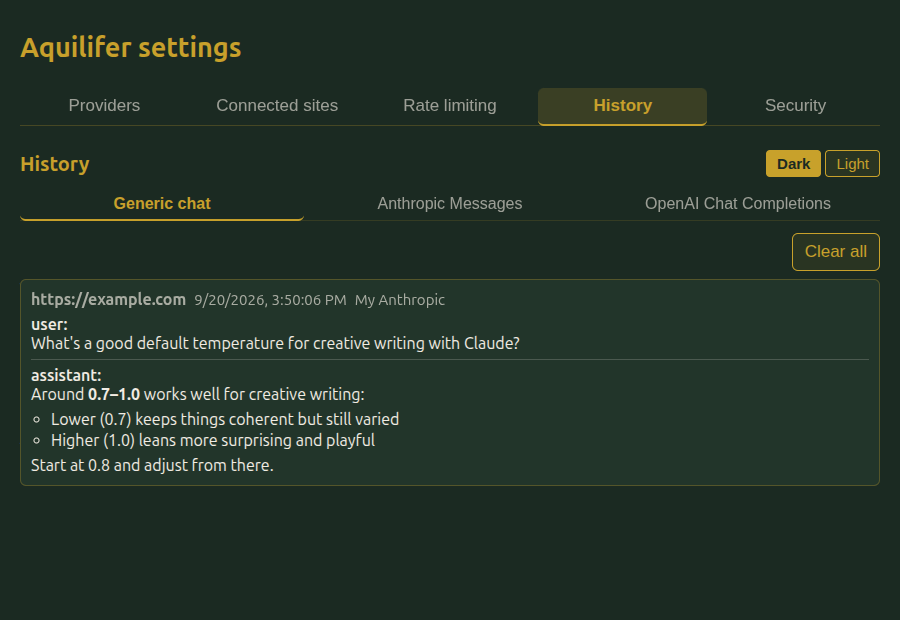
It's audit-only, never replayed
Aquilifer never feeds history back into a future request. Every call is stateless: a site sends the full conversation it wants answered on that one call, exactly like calling the underlying provider's API directly. This is deliberate: it avoids silent, creeping token costs from an ever-growing conversation you didn't ask to keep paying for, and it means history is purely something you can look back at, not something that quietly affects behavior.
Kept separately per interface
Aquilifer's generic chat interface and each provider-specific interface keep their own history log, viewable from separate tabs, so if you only ever use one, its log doesn't get lost in a mix of everything.
The generic chat tab renders prompts and responses as real markdown (headings, code blocks, lists, and the like) instead of showing the raw ##/``` syntax as plain text. The provider-specific tabs (Anthropic Messages, OpenAI Chat Completions) show a compact JSON summary of the request/response instead, so those stay plain text.
Dark or light entry cards
History entries render on their own card, separate from the page's base background. A Dark/Light toggle next to the History heading switches which. Dark (the default) follows the same colors as the rest of the extension; Light uses a parchment-style card instead. Your choice is remembered.
What it doesn't do
- History is not sent anywhere; it's stored locally in the browser, like everything else Aquilifer keeps.
- It's not encrypted, even if you've turned on the vault: the vault only protects API keys. If you're typing anything sensitive into a site that uses Aquilifer, know that a record of it sits in local, unencrypted browser storage. See Limitations for more on this.
- A connected site can read its own history back (so it can show a user their own past requests, for example), never another site's.